

Table of Contents
- How a Circuit Breaker Protects Your Home
- The Four Reasons Breakers Keep Tripping
- How to Find Out What Is Tripping a Circuit Breaker
- Why a Breaker Keeps Tripping With Nothing Plugged In
- Is It Dangerous If a Circuit Breaker Keeps Tripping?
- What to Do When a Breaker Keeps Tripping After Reset
- What Not to Do When a Breaker Keeps Tripping
- Book a Licensed Electrician to Diagnose Repeated Trips
- Frequently Asked Questions
Last Updated: November 12, 2026
How a Circuit Breaker Protects Your Home
If you have ever wondered why do breakers keep tripping, start with this: a circuit breaker is a safety switch that cuts power when current flow exceeds a safe level. That single job protects your wiring, your appliances, and your family from overheating and fire. When you ask why do breakers keep tripping, the short answer is that the breaker is doing exactly what it was built to do.
Here is the key point most homeowners miss: a breaker is not an obstacle to reset. It is a protective device. According to Delta Wye’s analysis of residential electrical safety data, roughly 80% of residential breaker trips come from simple overloads. The other 20% trace back to short circuits or ground faults.
At Progressive Electric LV, our licensed electricians handle panel upgrades, wiring repairs, and EV charger installs across the area. A tripped breaker is information, not an inconvenience.
For a fuller overview of what causes a breaker to trip, see our guide on a circuit breaker that keeps tripping.
The Four Reasons Breakers Keep Tripping
Almost every repeated trip falls into one of four buckets. Knowing which one you are dealing with tells you whether to reset, unplug, or call for help. But before you sort a trip into a bucket, it helps to know what kind of breaker is doing the tripping, because a ground-fault or arc-fault breaker trips for reasons a standard breaker never will.
| Cause | Typical Sign | Safe to Handle Yourself? |
|---|---|---|
| Circuit overload | Trips when several devices run at once | Yes, by reducing load |
| Short circuit | Trips instantly, often with a spark or buzz | No, call an electrician |
| Ground fault | Trips with moisture or damaged insulation nearby | No, call an electrician |
| Faulty breaker or aging parts | Trips with little or no load | No, needs testing |
Circuit Overload: Too Many Devices on One Circuit
An overloaded circuit happens when you draw more amperage than the breaker rating allows. Plug several high-wattage appliances, such as a space heater, a microwave, and a hair dryer, into the same circuit and you can exceed its rated load quickly.
The fix is simple: move devices to another circuit or run high-draw appliances on a dedicated circuit. New EV chargers and smart home devices are now a common cause of overload trips in 2026 homes, per TechnicallySteve’s electrical breakdown.
Short Circuit and Ground Fault: Damaged Wiring or a Failed Appliance
A short circuit occurs when a hot wire touches a neutral or ground wire. A ground fault occurs when current leaks to the ground through moisture or damaged insulation. Both are electrical faults, and both trip the breaker immediately.
Watch for a burning smell, sparks, buzzing, or a warm outlet. Any of these means stop resetting and call a licensed electrician. If you suspect wiring damage, our checklist on signs of faulty house wiring helps you confirm the risk before you book.
Faulty Breaker or Aging Electrical Components
Sometimes the breaker itself is the problem. A faulty breaker can trip with nothing plugged in, or fail to trip when it should. Aging equipment and loose connections inside the panel cause nuisance trips that look like overloads but are not.
This is where a professional test matters. A breaker that trips under light load needs replacement, not another reset.
AFCI, GFCI, and Dual-Function Breakers: When the Trip Is Protective, Not a Defect
Many homes now have breakers that look for specific hazards, not just excess current. A ground-fault circuit interrupter (GFCI) breaker trips when current leaks to ground, the kind of leak that can shock a person near a sink, tub, or outdoor outlet. An arc-fault circuit interrupter (AFCI) breaker trips when it senses the signature of a dangerous electrical arc, such as a damaged cord or a loose connection inside a wall. A dual-function breaker does both jobs in one slot.
These breakers are designed to trip on conditions a standard breaker would ignore, so a trip on a GFCI or AFCI circuit is not automatically a sign of a bad breaker. A common pattern is a GFCI breaker that trips when a bathroom fan, an outdoor receptacle, or a pool pump motor gets wet or ages. An AFCI breaker may trip on a vacuum cleaner with a worn cord, a failing lamp, or a shared neutral between two circuits.
Watch out: do not assume a tripping AFCI or GFCI breaker is defective and swap it for a standard breaker. That removes the protection the circuit was built to provide and can turn a nuisance trip into a shock or fire hazard. If a GFCI or AFCI trips repeatedly with nothing plugged in, the correct next step is a licensed electrician, not a replacement breaker from the hardware store.
How to Find Out What Is Tripping a Circuit Breaker
Finding the cause takes a calm, step-by-step approach with clear stop conditions. Do not skip steps, and never work inside the panel with the main power on. The goal is not to fix the wiring yourself, it is to gather enough information to know whether you have an overload, an appliance fault, or a wiring problem that needs a licensed electrician.
- Reset the breaker once. Push the handle fully to OFF, then to ON. If it will not stay on, stop here, do not reset again.
- Note the timing. Does it trip in seconds, minutes, or hours? Instant trips point to a short circuit or ground fault. Delayed trips point to overload or an overheating appliance. Trips that happen only when a specific device starts point to that device.
- Unplug everything on that circuit, including small chargers, power strips, and devices you forgot were connected. A single plugged-in phone charger can complete a fault path.
- Reset again. If it holds with nothing plugged in, the circuit wiring is likely intact and an appliance is the culprit. If it trips with nothing plugged in, stop, that points to wiring, a shared neutral, or a failing breaker, and it is time for a professional.
- Add devices back one at a time. Plug in and run each device until the breaker trips. The last one added is your suspect. Run it on its highest setting, because some appliances only draw enough current to trip at full load.
- Isolate the appliance. Move the suspect device to a different circuit. If it trips that circuit too, the appliance is the problem. If it runs fine elsewhere, the original circuit may be overloaded or have a wiring issue.
- Log the pattern for a week. Write down the time, the devices running, and whether the trip was instant or delayed. A pattern of trips at the same time each day, say, when the dryer and microwave run together, points to overload. Random trips with light load point to a wiring or breaker fault.
- Label the panel. Write down which breaker controls which room so the next trip takes seconds, not hours.
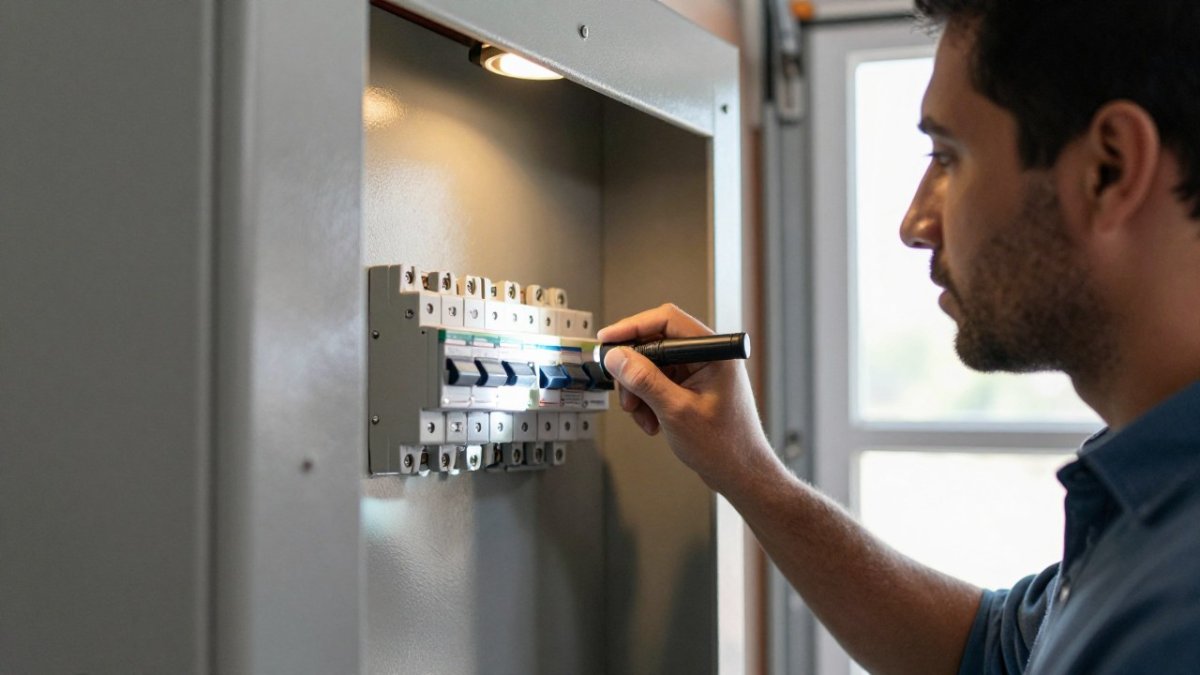
The man is American.
A common pattern is a breaker that holds with everything unplugged but trips the moment a specific appliance starts. That is usually the appliance, not the circuit. The opposite pattern, a breaker that trips with nothing plugged in, or trips at random times with light load, is the one that needs a meter and a trained eye.
Watch out: if the breaker trips instantly after reset, stop resetting it. Repeated resets into a fault can damage the breaker and stress the wiring, and they do nothing to find the cause. If the breaker trips with everything unplugged, do not open the panel to investigate, that is electrician-only work.
Why a Breaker Keeps Tripping With Nothing Plugged In
A breaker that trips with nothing plugged in almost always means a wiring fault, a shared neutral, or a failing breaker. The circuit is still carrying a path to ground somewhere you cannot see.
Common culprits include:
- Damaged wiring inside a wall
- A loose connection at a receptacle or switch
- Moisture reaching an outdoor or pool circuit
- A breaker that has simply worn out
This is not a reset-and-forget situation. A breaker tripping with no load is responding to a real condition inside your electrical system. Per ADC’s guidance on repeated breaker trips, repeated trips are a protective response that warrants professional attention.
Is It Dangerous If a Circuit Breaker Keeps Tripping?
Yes, a breaker that keeps tripping can be dangerous. It is telling you something in the circuit is drawing too much current, shorting, or leaking to ground. Ignoring it raises your fire risk.
The good news: a single trip from an overload is normal and safe. The concern is repeated tripping, especially when it happens fast or comes with heat, smell, or sound.
Treat these as warning signs and call an electrician:
- Burning smell near the panel or an outlet
- Scorch marks or discoloration
- Buzzing or crackling sounds
- A warm outlet or switch plate
- Trips that get more frequent over time
If a trip happens alongside smoke, sparks, or a shock, treat it as an emergency. Our guide on what to do during an electrical emergency walks you through the first steps safely.
What to Do When a Breaker Keeps Tripping After Reset
A breaker that trips again right after reset is different from one that trips once a month. The pattern tells you a lot.
Trips instantly after reset: Stop resetting it. An instant trip points to a short circuit or ground fault. Repeated resets into a fault can damage the breaker and stress the wiring.
Trips after a few minutes: This is usually an overload or an overheating appliance. Unplug devices and test one at a time.
Trips at random times: Loose connections, shared circuits, or a failing breaker are likely. These need a meter and a trained eye.
What most guides miss is that the timing is the diagnosis. A breaker that trips the moment you flip it is a very different problem from one that trips at 7 p.m. when the dryer runs. Write down when each trip happens for a week. That log saves your electrician time and gets you a faster, more accurate answer.
What Not to Do When a Breaker Keeps Tripping
Some shortcuts make the problem worse. Avoid all of these.
- Do not install a higher-amp breaker. The breaker is sized to protect the wire. A bigger breaker lets the wire overheat and start a fire.
- Do not tape or jam the breaker handle. You are defeating the one device protecting your home.
- Do not keep resetting into a fault. If it trips instantly, stop.
- Do not open the panel unless you are trained and the main power is off.
- Do not ignore a burning smell or warm outlet. Those are fire risks, not quirks.
- Do not swap breakers without matching the rating to the wire gauge and circuit capacity.
Watch out: replacing a 15-amp breaker with a 20-amp breaker to “stop the trips” is one of the most common and most dangerous DIY mistakes we see. It hides the symptom and removes the protection.
Book a Licensed Electrician to Diagnose Repeated Trips
Repeated tripping has a cause, and a licensed electrician can find it with the right tools. A licensed electrician can test breakers, trace circuits, check connections, and assess whether your panel can carry your home’s load.
A modern home pulls more power than it did a decade ago. EV chargers, heat pumps, and smart devices all add to the electrical load. Sometimes the answer is a simple repair. Sometimes it is a panel upgrade or a new dedicated circuit.
Before you book anyone, read our guide on hiring a licensed electrician so you know what to check. When you are ready, reach out through our contact page and we will schedule a visit.
Progressive Electric LV is a local, family-owned business with fully licensed electricians serving homes and businesses across the area. We handle panel upgrades, wiring repairs, EV charger setups, lighting installs, and pool and spa electrical work. The work is backed by dozens of five-star reviews.
Do not wait for the next trip. Get started with Progressive Electric LV and get your electrical system checked by a licensed professional.
A breaker that keeps tripping is your home telling you something needs attention. The fix may be as small as moving a space heater to another outlet, or as important as replacing damaged wiring. Either way, you do not have to guess.
Frequently Asked Questions
How many times can a breaker trip before it goes bad?
There is no fixed trip count that means a breaker is worn out. What matters is the pattern: a breaker that trips repeatedly under normal loads, feels warm at the handle, or will not stay reset is a candidate for replacement. A breaker that trips once after a heavy load and resets cleanly is usually fine. Any breaker that keeps tripping should be tested by a licensed electrician rather than reset again and again.
Why does my breaker keep tripping in one room?
A single room that trips repeatedly usually has too many loads sharing one circuit, or one device in that room with a fault. Unplug everything on that circuit, reset the breaker, then add devices back one at a time until it trips. If it trips with the room empty, the problem is in the wiring or the breaker itself, and that needs a licensed electrician to trace.
Can I just replace the breaker with a higher amp rating?
No. The breaker rating is matched to the wire size it protects. A 20-amp breaker on 14-gauge wire can overheat the wire before the breaker trips, which raises fire risk. If a circuit genuinely needs more capacity, the correct fix is a new dedicated circuit or a panel upgrade sized for the load, not a larger breaker.
Why does my breaker trip when I plug something in?
A trip the moment a device is plugged in points to that device or its cord. The appliance may have an internal short, a damaged plug, or a ground fault. Try the device on a different circuit; if it trips there too, stop using it and have it repaired or replaced. If only one outlet trips, the receptacle or the wiring behind it needs inspection.
