

Quick Summary
Professional EV charger installation cost typically averages around $967 for a home Level 2 charger, based on Angi’s 2026 analysis of 4,398 verified projects. Costs rise with panel capacity, distance from the electrical panel, and permit requirements.
- Residential Level 2 installation usually runs $800 to $3,000 before equipment, per EcoFlow US benchmarks.
- A panel upgrade can add $2,000 to $5,000 to the project, according to NeoCharge research.
- Request a load calculation in writing before approving any panel work.
- A federal Section 30C credit can cover up to 30% of qualifying costs, subject to eligibility.
- Ask every installer for an itemized quote with the same scope to compare bids fairly.
Table of Contents
- What Professional EV Charger Installation Costs in 2026
- Charger Hardware Versus Electrician Labor
- Cost to Install a Level 2 Charger at Home
- EV Charger Installation Panel Upgrade Cost
- How Much a Commercial EV Charging Station Costs
- EV Charger Installation Tax Credit and Net Cost
- Comparing Quotes and Choosing an Installer for Your Project
- Frequently Asked Questions
What Professional EV Charger Installation Costs in 2026
Last Updated: November 10, 2026
Installing a home EV charger professionally typically costs around $967 on average, according to Angi’s 2026 analysis of 4,398 verified projects from Angi Pros (Angi’s 2026 analysis of EV charger installation costs). At Progressive Electric LV, we see that number move with the condition of the home, so the first step is understanding what sits inside that figure.
The cost of professional EV charger installation is shaped by the electrical work around the charger as much as by the charger itself. A typical residential Level 2 installation runs from $800 to $3,000 before equipment, based on benchmark figures published by EcoFlow US (EcoFlow US residential Level 2 installation benchmarks). Commercial projects sit far higher, with Level 2 ports costing $3,000 to $12,000 or more each.
A better question than a single number is what a home needs to support a charger safely. A short run from a panel with spare capacity generally involves less work than a long run that requires a new circuit and a panel upgrade.
Cost drivers that matter most:
- Distance between the electrical panel and the charger location
- Available capacity in the existing panel
- Whether the work requires trenching, conduit or new breakers
- Local permit and inspection requirements
Getting an itemized quote rather than comparing headline prices is a sound approach. A quote that lists labor, materials, permit fees and any panel work lets you compare bids on equal terms.
Charger Hardware Versus Electrician Labor
The charger unit is usually the smaller part of the bill. The unit alone rarely determines the total. Electrician labor, wiring materials and the dedicated circuit often make up most of the project.
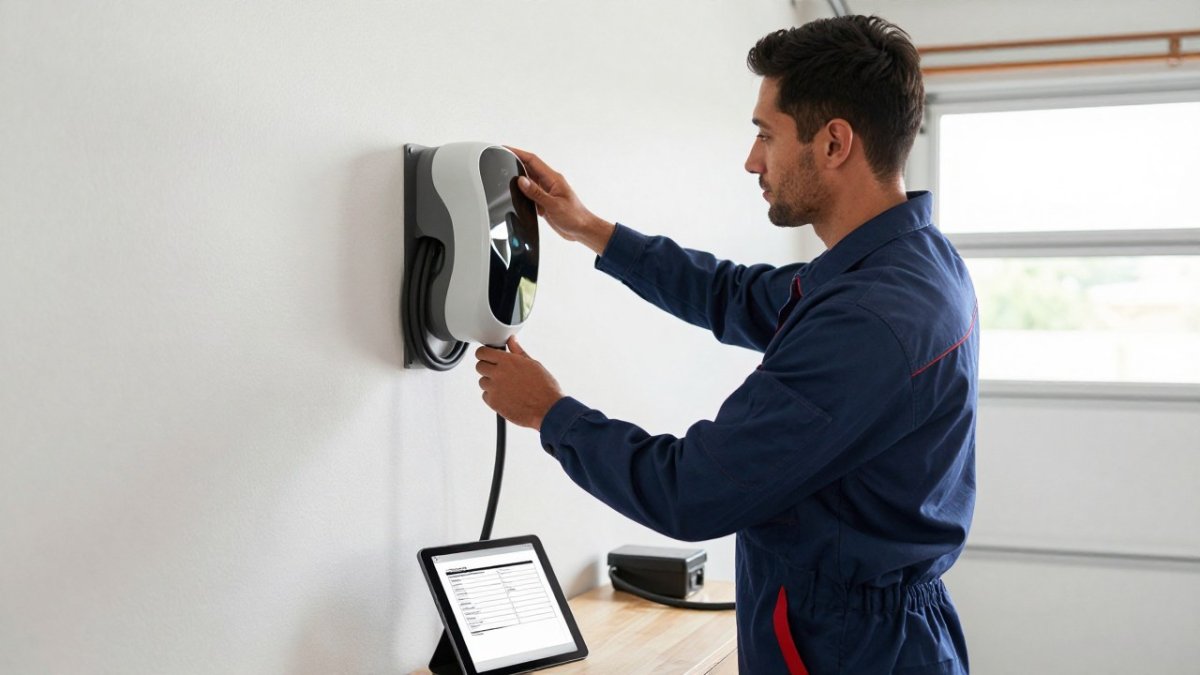
When you review a quote, check whether the charger is listed separately from installation. Some bids bundle the unit into a single price, while others itemize equipment, labor and materials. Itemized quotes make it easier to see where money goes and whether a lower price has cut corners on wire gauge or breaker size.
Watch out: a quote that leaves out permit fees or panel inspection can look cheaper on paper and cost more once the city adds those charges.
Cost to Install a Level 2 Charger at Home
A new 240-volt circuit with a short run from a panel that has capacity typically costs about $750 to $1,500 installed, according to NeoCharge’s installation guidance (NeoCharge guide to home charging station installation costs). Longer runs, wall repairs or a panel that needs work push the total higher.
Qmerit’s installation data reports an average of $1,700 for residential Level 2 installs (Qmerit EV charger installation cost guidance). That figure reflects a mix of homes, so your own cost depends on the wiring path and electrical service.
The Home Depot lists a typical range of $899 to $1,999 for its EV charger installation service and offers a free project quote (The Home Depot EV charger installation service page). These benchmarks help you judge whether a bid falls in a reasonable range.
Typical home Level 2 installation figures from the benchmarks cited in this guide:
| Source | Figure | Scope |
|---|---|---|
| NeoCharge | $750 to $1,500 | New 240-volt circuit, short run, panel with capacity |
| Qmerit | $1,700 average | Residential Level 2 installs |
| The Home Depot | $899 to $1,999 | EV charger installation service range |
EV Charger Installation Panel Upgrade Cost
Panel capacity is the factor most likely to change your bill. Many older homes, including those built before the 1990s, have 100-amp service that cannot support a charger alongside other large loads. Installers often recommend a load calculation before committing to a charger size.
Panel upgrades can add $2,000 to $5,000 to a project, according to NeoCharge’s industry research (NeoCharge analysis of electrical panel upgrade costs). That range covers a new 200-amp panel, new breakers, permit fees, and the labor to move existing circuits. A service upgrade that requires a new meter base or utility coordination can land at the top of that range or above.
Before accepting that cost, ask whether load management can work instead. Three mechanisms are worth understanding:
- Load sharing lets two or more chargers split a single circuit’s capacity. If you own one EV today but expect a second, a load-sharing setup can avoid a second dedicated circuit and the panel work that comes with it.
- Smart charging uses a current sensor at the service panel to throttle the charger when other large loads, an electric range, dryer, or HVAC compressor, are running. The charger still delivers full power overnight when the house is quiet.
- Circuit management (sometimes called an energy management system) sheds or pauses non-critical circuits so the charger can run at a higher amperage without exceeding the panel’s rating.
A load calculation is often a practical way to settle the question. A licensed electrician performs a service load calculation using the method in NFPA 70 (the National Electrical Code), which compares the existing service rating against the calculated demand of the home plus the charger. If the calculation shows headroom, no upgrade is needed. If it shows a deficit, load management may close the gap for less than a full service upgrade.
Ask for the load calculation in writing before you approve panel work, so you can confirm whether the upgrade is needed.
If you are charging only one vehicle, a load study is worth paying for. It may show that a smaller charger or managed circuit fits your existing service. A 40-amp or 48-amp hardwired charger is the common choice for a single vehicle, but a 32-amp or 24-amp charger on an existing circuit can meet most overnight commutes without touching the panel.
How Much a Commercial EV Charging Station Costs
Commercial projects are priced very differently. GreenLancer lists installation costs of $3,000 to $12,000 or more per Level 2 port, and $80,000 to $250,000 or more for a DC fast charger (GreenLancer guide to commercial EV charging station costs). Verdek reports that a single DC fast charger typically costs $80,000 to $250,000 installed, with hardware alone running about $35,000 to $140,000 (Verdek commercial EV charging station cost analysis).
Commercial figures are not a guide for a home charger. Property managers generally need to account for transformer capacity, network software and ongoing maintenance, not just the hardware line item.
EV Charger Installation Tax Credit and Net Cost
Upfront price and net cost are two different numbers, and the gap between them is where most cost guides get vague. A federal tax credit under Section 30C can cover up to 30% of qualifying charger and installation costs for personal use infrastructure, according to Plug In America (Plug In America summary of the federal 30C charger credit). Eligibility depends on your income, location, and the equipment installed, so confirm details with the IRS before filing.
Three details decide whether the credit actually lowers your bill:
- Tax credits generally reduce the tax you owe rather than paying you directly. Check the rules that apply to your return before counting on the credit.
- Timing follows the tax year of installation. Budget for the full upfront cost and treat any credit as a later offset.
- Location and equipment rules may apply. Confirm eligibility requirements before you buy.
Utility rebates and state programs may reduce the cost further. Check your utility’s website for current offers, because program funding and eligibility change from year to year.
When you calculate net cost, subtract the expected credit and rebates from the final installed price. Then compare that figure against the charging you expect to do at home, since EV owners in one large study reported charging privately, at home or work, nearly 75% of the time (International Energy Agency Global EV Outlook 2026).
Average home charging spending is also rising. J.D. Power’s 2026 study found monthly spending increased to $63, up $5 from the prior year (J.D. Power 2026 U.S. Electric Vehicle Experience Home Charging Study). Over a year, that is roughly $756 in electricity, a figure worth weighing against the installed price when you decide whether a charger pays back.
Ask for the gross installed price and the incentive assumptions in writing before comparing bids.
Comparing Quotes and Choosing an Installer for Your Project
Ask every installer for the same scope in writing: charger model, cable length, circuit size, conduit type, panel work, permit handling and warranty. Bids that describe different work cannot be compared fairly, even when the total looks similar.
Confirm that the electrician is licensed and insured, and ask who pulls the permit. A licensed installer knows local code requirements and can tell you whether your panel needs an upgrade before work begins. Progressive Electric LV can walk you through that check; see our residential EV charger installation requirements in Las Vegas before you request a quote.
If panel work is likely, review our electrical panel upgrade service and compare panel upgrade pricing by amperage so you know what a full upgrade involves. For tips on verifying an installer, read how to hire a licensed electrician in Las Vegas.
When you’re ready, request an EV charger installation estimate from Progressive Electric LV and compare the itemized scope against the bids you collected.
Frequently Asked Questions
How much does it cost to install an EV charger at home?
Costs vary with the condition of the home and the electrical work involved. Your total depends on whether your existing 240-volt circuit can be reused, how far the charger sits from the panel, and what permits your local jurisdiction requires. Ask for an itemized quote so you can see the charger, labor, materials and permit lines separately.
Does installing a Level 2 EV charger require a panel upgrade?
Not always. A panel upgrade becomes necessary when your main panel lacks spare capacity for a dedicated 240-volt circuit. Panel upgrades add to the cost of a project. Before assuming you need one, have an electrician perform a load calculation. Load management equipment can sometimes allow a charger to run on a smaller circuit without replacing the panel, which can lower the upfront cost considerably.
Is there a federal tax credit for EV charger installation?
Federal tax credits for EV charger installation may be available. Credits generally reduce the tax you owe rather than paying you directly. Eligibility depends on the property’s location and your income, and the rules can change. Confirm current requirements with a tax professional before you count the credit in your budget.
How much does a commercial EV charging station cost?
Commercial pricing varies with port type, site capacity and project scope. These figures differ sharply from residential pricing because commercial projects involve higher-capacity service, multiple ports and more extensive permitting. Pricing for any specific site depends on its electrical capacity and project scope, so request a site assessment for an accurate figure.
