

Last Updated: October 30, 2026
Quick Summary
Residential EV charger installation in Las Vegas starts with a check of your electrical panel, since its main breaker size decides how much power your home can safely draw. A Level 2 charger generally needs a dedicated 240-volt circuit, and most installations require a permit and inspection.
- Check your main breaker size, which is usually printed at the top of the panel.
- Look for open slots for a new double-pole breaker.
- Multiply the charger’s amp rating by 1.25 to size the circuit.
- Most EV charger installations need a permit and an inspection before the charger is energized.
- Warm spots, burning smells, or frequent breaker trips mean you should call a licensed electrician first.
Table of Contents
- Checking Your Electrical Panel Before You Book
- Level 2 EV Charger Electrical Requirements
- Circuit Sizing and Dedicated Circuit Rules
- EV Charger Installation Permit Requirements
- Planning Your Home EV Charger Installation Cost
- Scheduling Your Licensed Electrician Visit
- Frequently Asked Questions
Checking Your Electrical Panel Before You Book
Before you schedule anything, look at your electrical panel. Your panel’s main breaker rating tells us how much power your home can safely draw. Many Las Vegas homes have 100-amp or 200-amp service, and that number decides a lot about what your EV charger needs.
Progressive Electric LV starts EV charger jobs with a panel check, and a licensed electrician can review the service size, open breaker spaces, and condition of existing wiring with you. If you want to know whether your panel can take a charger, book a panel review with Progressive Electric LV.
Here is what to check on your own first:
- Main breaker size: Usually printed on the main breaker at the top of the panel.
- Open spaces: Look for empty slots for a new double-pole breaker.
- Panel age and brand: Some older panels have a history of problems and may need replacing.
- Signs of trouble: Warm spots, burning smells, or breakers that trip often.
If you see any of these warning signs, stop and call a licensed electrician before you add a charger.
Level 2 EV Charger Electrical Requirements
A Level 2 charger runs on 240 volts, the same type of power as your dryer or range. Level 1 chargers plug into a standard 120-volt outlet and charge slowly (Alternative Fuels Data Center: Electric Vehicle Charging Stations). Level 2 chargers are generally faster for daily charging.
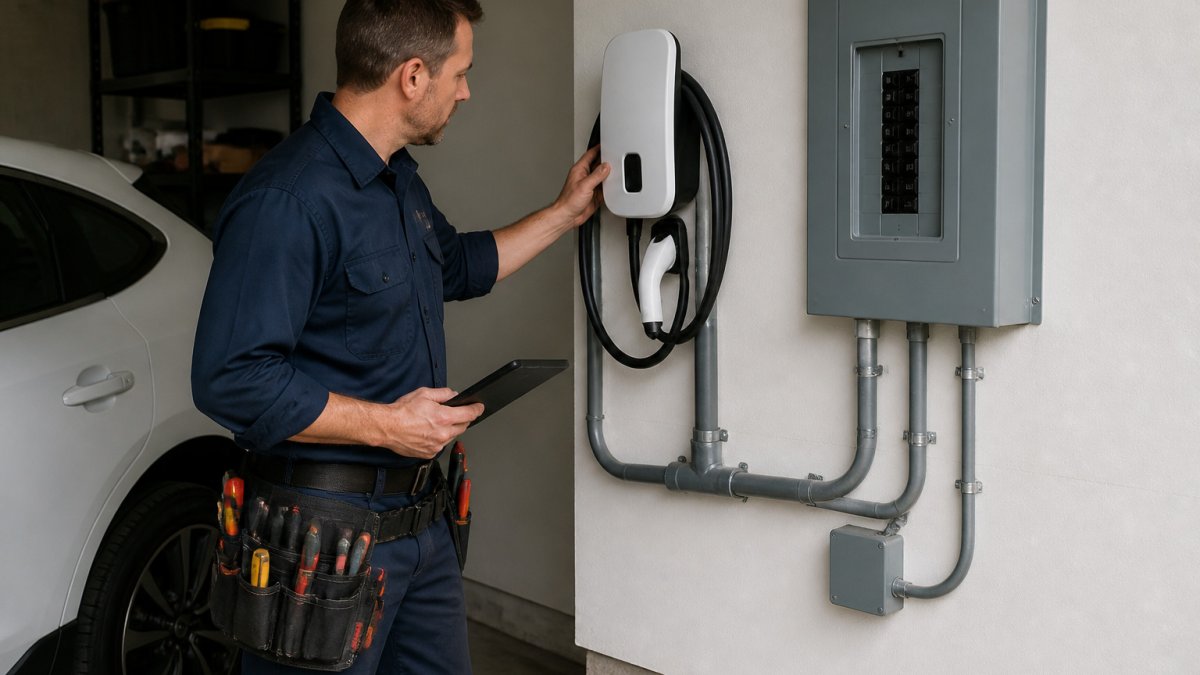
The electrical requirements for a Level 2 charger depend on the charger’s rating. Circuit sizing for a Level 2 charger is governed by the locally adopted National Electrical Code, so confirm the exact requirements with your electrician and local building department.
Your installer will also check the wire gauge, the conduit, and the outlet or hardwired connection. A licensed electrician can tell you which setup fits your home. You can read more about the full setup on our EV charging service page.
Watch out: Do not size the charger by the number of miles you drive. Size it by the circuit your panel can safely supply.
Circuit Sizing and Dedicated Circuit Rules
A Level 2 charger generally needs its own dedicated circuit, so it is not sharing the line with other outlets or appliances. Your electrician can confirm what your installation requires.
Here is how sizing usually works:
- Charger rating: Find the amp rating on the charger’s label.
- Circuit size: Multiply the charger rating by 1.25 and round up to the next standard breaker size.
- Wire gauge: The wire must match the breaker rating and the length of the run.
- Dedicated line: No other loads should share the circuit.
Many homeowners ask if they can skip the upgrade. That is a risky shortcut. An undersized circuit can overheat, trip often, or fail over time. Always have a licensed electrician confirm the circuit before the charger goes live.
Here is how sizing usually works for a Level 2 charger circuit, in the article’s terms.
| Item | Value | Note |
|---|---|---|
| Charger rating | Found on charger label | Amp rating sets circuit size |
| Circuit size | Charger rating × 1.25 | Round up to next standard breaker |
| Wire gauge | Matches breaker rating | Also depends on run length |
| Dedicated line | Not shared | No other loads on circuit |
EV Charger Installation Permit Requirements
Most EV charger installations need a permit. The local building department reviews the plan and inspects the finished work. Requirements vary by jurisdiction, so check with the city or county office that covers your address.
A typical permit process includes:
- A licensed electrician submits the load calculation and charger specs.
- The city or county reviews the plan.
- The electrician completes the installation.
- An inspector checks the work before the charger is energized.
Permit fees and timelines differ by location, so ask your electrician for the current amounts and steps for your area.
Planning Your Home EV Charger Installation Cost
The total cost of a home EV charger depends on the charger itself, the wiring run, and whether your panel needs an upgrade. Pricing depends on your home’s setup, so please contact Progressive Electric LV or visit our website for a quote.
Several factors change the final bill:
- Charger model: Higher-amp units cost more and may need a larger circuit.
- Wiring distance: Longer runs take more wire, labor, and conduit.
- Panel capacity: A full panel may need an upgrade before the charger can go in.
- Permits and inspection: Local fees add to the total.
Ask for a written quote that lists each item separately so you can compare options. Contact Progressive Electric LV for a quote.
If you want to see how panel upgrade pricing works, read our guide to electrical panel upgrade cost by amperage.
Scheduling Your Licensed Electrician Visit
When you are ready to move forward, schedule a visit with a licensed electrician. A good visit starts with a panel check, a review of your charger choice, and a written plan. Ask the electrician to confirm the circuit size, the permit steps, and the timeline before any work starts.
Have these details ready when you call:
- Your home’s main panel size, if you know it
- The make and model of the charger you want
- The location of the panel and the charging spot
- Any problems you have seen, like flickering lights or warm breakers
Progressive Electric LV is a local, family-owned business with fully licensed electricians, handling residential and commercial electrical work in Las Vegas. Reach out to schedule your visit.
Frequently Asked Questions
Do I need a permit to install an EV charger at home?
In most jurisdictions, yes. A Level 2 charger involves a new dedicated circuit, and a permit ensures the work is inspected against the locally adopted National Electrical Code. A licensed electrician can typically help with the permit process. Permit fees and inspection timelines vary by city and county, so confirm the requirements with your local building department before work begins. Skipping the permit can create problems with insurance claims and home sales.
Does a licensed electrician need to install a home EV charger?
A licensed electrician should handle the installation. Circuit sizing, breaker selection, conductor gauge and grounding all affect safety, and a licensed contractor carries the insurance and knowledge to pull permits and pass inspection. Ask any contractor you consider to confirm their license, insurance and whether they will handle the permit and inspection for you.
Can my electrical panel support a Level 2 EV charger?
Many homes can, but it depends on the panel rating and how much load is already in use. A 100-amp panel may need a load calculation or a service upgrade before adding a charger, especially if the home has electric heating, a large air conditioner or other high-draw appliances. An electrician can run a load calculation to determine whether you have spare capacity or need a panel upgrade.
Does a home EV charger need a dedicated circuit?
Yes. A Level 2 charger should run on its own dedicated circuit with a breaker sized for the charger’s rated current. Confirm the exact sizing with your electrician and local code.
