

Quick Summary
Many homes with a 100 amp panel can add a Level 2 EV charger, but whether yours can depends on its other loads and spare capacity. A licensed electrician must run a load calculation to confirm whether the panel needs an upgrade.
- Count the home’s major loads, such as electric range, dryer, water heater and air conditioner, against the 100 amp service.
- In the worked example, the electric-heavy home exceeded capacity while the gas-cooking home had about 11,425 watts of headroom.
- Service capacity, panel capacity and open breaker spaces are separate checks, and all three matter.
- Load management or adjustable charging current can sometimes avoid a full upgrade, at the cost of slower charging.
- Ask for an itemized quote that separates panel work, service upgrade, charger installation and permit fees.
Table of Contents
- Can a 100 Amp Panel Support an EV Charger?
- How a Load Calculation Determines Your Available Capacity
- Level 2 Charging Voltage, Amperage, and Charging Speed
- When a Panel or Service Upgrade Is Necessary
- Load Management for EV Charger Installations
- Upgrading 100 Amp Panel for EV Charger Cost
- Choosing the Best EV Charger for a 100 Amp Panel
- Booking Your Panel Assessment in Las Vegas
- Frequently Asked Questions
Can a 100 Amp Panel Support an EV Charger?
Last Updated: November 19, 2026
Many homeowners with a 100 amp panel can add a Level 2 EV charger, but not always without changes. Whether yours can depends on what else runs off the panel and how much spare capacity is left after those loads are counted.
The U.S. Environmental Protection Agency advises that a licensed electrician can determine whether an existing panel can handle a charger or needs upgrading, and that permits should be obtained before installation (EPA guidance on getting started with home EV charging). That assessment is the real answer, not a rule of thumb.
Rewiring America says most homes can fully electrify on an existing 100 amp panel, while EnergySage notes that a 100 amp panel may struggle to run modern appliances and an EV charger at the same time (Rewiring America’s electrification guidance). Both views can be true. The outcome depends on the home’s loads.
If you want a quick self-check before calling anyone, read our guide on how to tell if your 100 amp panel can handle an EV charger.
How a Load Calculation Determines Your Available Capacity
A load calculation adds up the electrical demand your home places on its service, then compares that total to the service rating. The difference is the capacity left over for an EV charger. An electrician does this with the National Electrical Code’s standard method, which is why a generic “100 amps is enough” answer is never reliable.
The calculation considers the size of the home, major appliances such as electric ranges, dryers and water heaters, and the heating and cooling system. Each load is treated differently. Continuous loads, which run for three hours or more, are weighted more heavily than occasional ones.
The result is a usable capacity figure, and a charger only fits if that figure leaves enough room for its circuit.
A Worked Load Calculation for a Typical 100 Amp Home
Consider a simplified example. A 100 amp, 240 volt service has 24,000 watts of total capacity. Suppose the home has a 1,500 square foot living area, an electric range, a 4,500 watt electric dryer, a 4,500 watt water heater and a 5,000 watt central air conditioner.
Under the standard method, the general lighting and receptacle load is calculated from floor area. Using the common 3 watts per square foot allowance, 1,500 square feet yields 4,500 watts. The small-appliance and laundry branch circuits add another 3,000 watts (1,500 watts each for two small-appliance circuits and one laundry circuit). That brings the general load to 7,500 watts before demand factors.
The standard method then applies a demand factor to the general load: the first 3,000 watts count at 100 percent, and the remainder counts at 35 percent. So 3,000 watts plus 35 percent of 4,500 watts (1,575 watts) gives 4,575 watts for the general lighting and receptacle load.
The large appliances are added at nameplate values. The electric range counts at 8,000 watts under the standard allowance for a single range. The dryer counts at 5,000 watts, and the water heater at 4,500 watts. The central air conditioner is added at its nameplate value of 5,000 watts. These four loads total 22,500 watts.
Adding the general load (4,575 watts) to the appliance load (22,500 watts) gives a calculated demand of 27,075 watts. That already exceeds the 24,000 watt capacity of a 100 amp service, which means this home would have no room for an EV charger without changes.
Now consider a leaner version of the same home: no electric range (gas cooking instead), no electric dryer (gas dryer), and a 3,000 watt water heater. The general load stays at 4,575 watts. The appliances now total 3,000 watts for the water heater plus 5,000 watts for the air conditioner, or 8,000 watts. The calculated demand is 12,575 watts, leaving roughly 11,425 watts of headroom on the 24,000 watt service.
A 32 amp charger draws a continuous load of about 7,680 watts on a 240 volt circuit. In the leaner home, that fits within the remaining capacity. In the first home, it does not. Same 100 amp service, opposite answers, because the loads differ.
These numbers are illustrative and use simplified assumptions. Your actual result needs a site-specific calculation, and an electrician may apply optional methods or account for loads this example omits.
Panel Capacity, Service Capacity, and Open Circuit Spaces
These three terms are often confused, and they answer different questions.
- Service capacity is the amperage rating of the incoming power from the utility, such as 100 amps.
- Panel capacity is the physical space and rating of the panel that distributes that power to circuits.
- Open circuit spaces are the empty slots in the panel where a new breaker could be installed.
A panel can have open slots and still lack enough service capacity. The reverse can also happen: a panel with no open slots may sit on a service with plenty of headroom, in which case a subpanel or a tandem breaker can solve the space problem without touching the service. Checking all three is part of a proper assessment, and it explains why two electricians can quote very different scopes for what sounds like the same job.
The article’s worked example shows how the same 100 amp service can give opposite answers depending on the home’s loads.
| Home | Calculated demand | Headroom on 24,000 W service |
|---|---|---|
| First home (electric range, electric dryer) | 27,075 W | None, exceeds capacity |
| Leaner home (gas range and dryer) | 12,575 W | About 11,425 W |
Level 2 Charging Voltage, Amperage, and Charging Speed
Most home chargers are Level 2 units that run on a 240 volt circuit. The circuit amperage and the charger’s own setting together determine how fast the car charges.
A common rule for planning is that a 240 volt charger draws roughly the amperage it is set to, with the breaker sized at 125 percent of the continuous load. A 40 amp charger therefore typically needs a 50 amp circuit.
Charging speed depends on the car’s onboard charger and the amperage supplied. Lower amperage means slower charging, which can still be enough for overnight charging if daily driving is modest. A household that drives 30 miles a day usually needs far less charging time than one that drives 150 miles.
Reducing charging current is one way to fit a charger on a limited panel, and the tradeoff is slower charging.
When a Panel or Service Upgrade Is Necessary
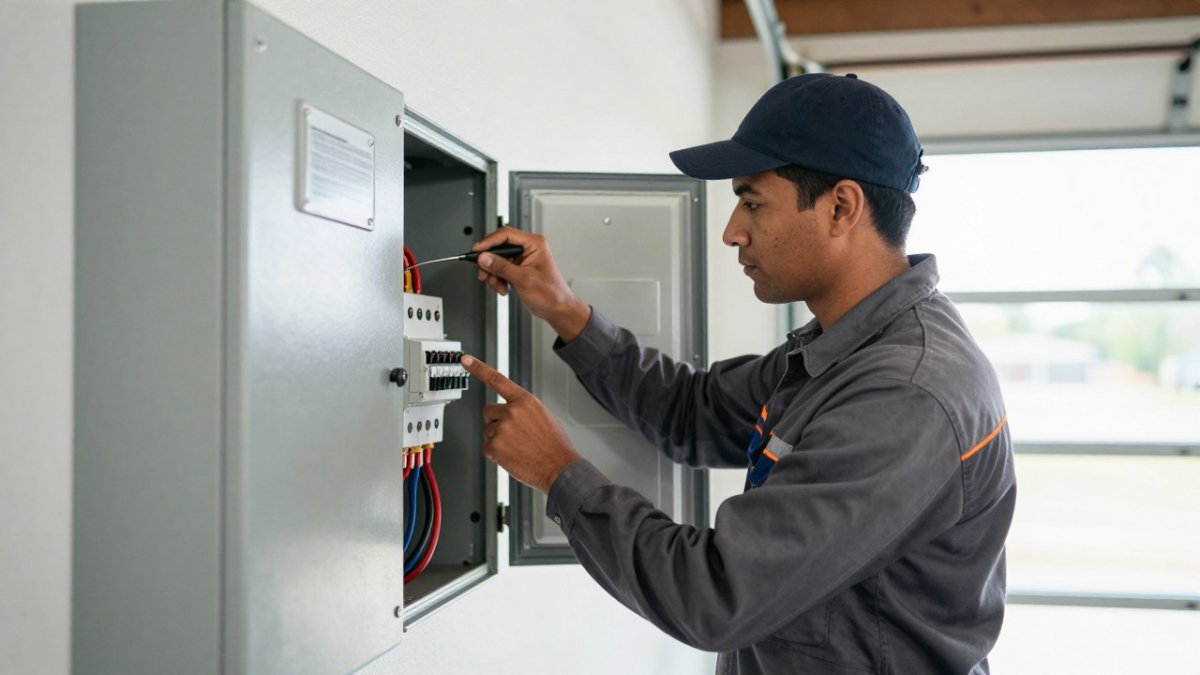
An upgrade becomes necessary when the load calculation shows no workable room for the charger, even after adjusting it. Common signs include breakers that trip under normal use and lights that dim when large appliances start.
Other scenarios that often require more capacity:
- Several large loads, such as an electric range, dryer, water heater and heat pump, running together
- A home with a detached garage or long cable runs that complicate the charger circuit
- Planned additions, such as a pool heater or a second EV
A panel upgrade replaces the main panel with a larger one. A service upgrade replaces the incoming service, often increasing it to 200 amps. Scope, cost and timing differ between the two, and a licensed electrician can say which applies.
Permits and inspections are normally required for this work. Utility coordination may be needed for a service upgrade, which can extend the timeline.
Load Management for EV Charger Installations
Load management lets a charger reduce its draw when the home’s other loads are high, so the total stays within the service rating. A load-sharing device monitors current and throttles the charger automatically.
This can avoid a full upgrade in some homes. It also has limits. A charger on a managed circuit may charge slower during peak household use, and the device itself is an added cost and component to maintain.
Smart chargers with adjustable current offer a similar benefit. They let you set a lower charging rate or schedule charging for times when fewer appliances are running.
Load management works best when the home has moderate loads and the owner accepts variable charging speed. It is less suitable for large, always-on demands.
Upgrading 100 Amp Panel for EV Charger Cost
Costs vary with the scope of work, so treat any figure as a range rather than a quote. Costs depend on the scope of the work, so the only reliable figure is one from a site assessment. Progressive Electric LV does not publish fixed prices, so contact the company or visit its website for a current quote.
A more useful way to plan is to break the project into its parts, because the total depends on which parts you actually need: the charger unit, the circuit wiring and breaker, any panel replacement or service upgrade, permit and inspection fees, and any utility coordination. Each of these depends on the home’s specifics, so ask for an itemized quote.
Watch out: a quote that bundles “panel upgrade” and “service upgrade” into one line can hide whether the utility work is included, so ask for those items separated.
Your final cost depends on the panel’s condition, the distance from the panel to the charger, permits, and whether the utility must be involved. Ask for an itemized estimate so you can compare the panel work with the charger installation.
For reference on the charger side, see our breakdown of professional EV charger installation costs and the panel upgrade pricing by amperage. Whether a full upgrade is worth it for one car depends on how much room the existing panel has, which is why a proper assessment comes first.
Panel upgrade cost estimates by source
Choosing the Best EV Charger for a 100 Amp Panel
The right charger fits the circuit you can realistically provide. On a 100 amp panel with limited spare capacity, a lower-amperage or adjustable charger is often the practical choice.
Look for these features:
- Adjustable current setting, so the charger can match the available circuit
- Load management compatibility, if the home needs it
- Listing by a recognized testing laboratory and compatibility with your vehicle
- Scheduling or app controls, which help manage peak household use
We recommend choosing the charger after the load calculation, not before. A charger bought without that information can end up oversized for the panel.
Booking Your Panel Assessment in Las Vegas
The fastest way to know your options is a site assessment. A licensed electrician can run the load calculation, check open breaker spaces, confirm service capacity and recommend whether load management, reduced charging current or an upgrade fits your home.
Progressive Electric LV is a local, family-owned business with fully licensed electricians serving Las Vegas. If you are ready to plan your charger, you can book an EV charger installation in Las Vegas and get a clear answer on your panel.
Your 100 amp panel may already support an EV charger, but only a proper assessment can confirm it. Progressive Electric LV can evaluate your panel, recommend the right charger and handle any upgrade work. Call us to schedule your assessment.
Frequently Asked Questions
Can I add an EV charger to a 100-amp panel?
Often yes, but not always. Whether a 100-amp panel can take a Level 2 charger depends on the home’s existing electrical loads and available capacity, which a licensed electrician determines with a load calculation. Some homes can add a charger with load management or a dedicated circuit, while others need a service upgrade to 200 amps. The Environmental Protection Agency advises having an electrician assess the existing panel and obtain permits before installing a home charger. A professional assessment is the only reliable way to know which path fits your home.
How much does it cost to upgrade a panel from 100 amps to 200 amps?
Actual cost depends on the home’s wiring, permitting, and the scope of work. Progressive Electric LV does not publish fixed prices, so contact the company for a quote specific to your property.
Can a load-managed EV charger work with a 100-amp panel?
Load management can allow a charger to run on a 100-amp panel by reducing charging current when other household loads are in use. EnergySage describes circuit-sharing and similar approaches as possible workarounds, but notes that a 100-amp panel may struggle to support modern appliances and an EV charger at the same time. Whether load management is suitable depends on how much electricity the rest of the home draws. An electrician can confirm whether a managed charger is appropriate for your specific load profile.
Can I install an EV charger myself?
Installing a Level 2 charger involves a dedicated circuit, breaker sizing, and wiring that must meet the National Electrical Code and local permit requirements. The EPA recommends having an electrician determine whether the existing panel can handle a charger and obtain the required permits. Mistakes in load sizing or connections can create fire risks and may void insurance coverage. For most homeowners, hiring a licensed electrician is the safer and more reliable choice.
What is the best EV charger for a 100-amp panel?
The best charger for a 100-amp panel is usually an adjustable-current Level 2 unit that can lower its output when other loads are running. Adjustable or smart chargers let you set a maximum amperage that fits your panel’s available capacity, which can avoid a costly service upgrade. Your electrician should match the charger’s rated current to the circuit and breaker you plan to use. Contact Progressive Electric LV to discuss your options.
How do electricians determine whether a 100-amp panel can support EV charging?
Electricians perform a load calculation that totals the home’s major loads, such as heating, cooling, cooking, water heating, and laundry, and compares that total against the service rating. The difference between the calculated load and the 100-amp capacity indicates the available capacity for a charger. They also check open breaker spaces and the condition of the existing wiring. If the remaining capacity is too small for the charger you want, a service upgrade or load management is typically recommended.
