

Last Updated: November 2, 2026
Quick Summary
Smart home lighting lowers electricity use, adds remote control from a phone, and supports automation like schedules, motion sensing and voice commands. Energy savings come from LED bulbs and from controls that cut the hours lights stay on at full brightness.
- LED bulbs convert most input into light rather than heat, drawing far less power than incandescent or halogen bulbs.
- Smart controls such as dimming and occupancy sensing cut empty-room hours that manual switches miss.
- Use smart bulbs for lamps and portable lights, and smart switches for fixed ceiling lights you control as a group.
- Confirm the protocol, platform and wiring before buying, since Zigbee and Z-Wave require a hub and smart switches need a neutral wire.
- Check current pricing with the manufacturer or a licensed installer, because prices change frequently.
Table of Contents
- How Smart Home Lighting Systems Reduce Energy Use
- Convenience and Control From Anywhere
- Automation, Schedules and Voice Control
- Home Security Benefits of Smart Lighting
- Smart Bulbs vs. Smart Switches: Which Fits Your Home
- Costs, Trade-offs and Installation: Planning Your Smart Lighting Upgrade
- Booking Your Smart Lighting Consultation With Progressive Electric LV
- Frequently Asked Questions
Smart home lighting is one of the simplest upgrades a homeowner can make, and the benefits go well beyond turning lights on from a phone.
The research available to us on this topic is limited, so we focus on the practical side. We explain what smart lighting does, where the benefits come from, and what to check before you buy. We also point you to the official sources you need for current pricing and product details.
How Smart Home Lighting Systems Reduce Energy Use
Smart lighting lowers electricity use through two separate mechanisms, and it helps to keep them apart when you estimate savings. You can see the LED options and installation details on our LED lighting installation in Las Vegas page.
The first is the bulb itself. Department of Energy publishes guidance on LED efficiency and on lighting standards, and it is worth reading before you plan an upgrade (Purchasing Energy-Efficient Light Bulbs). U.S. Department of Energy guidance on efficient LED lighting
The second is the control layer. Smart schedules, motion sensors, dimming and geofencing reduce the hours a light is on at full brightness.
To estimate savings for your own home, use this sequence:
- List the fixtures you will convert and the wattage of the bulbs in them now.
- Estimate the hours each fixture currently runs per day, including the hours nobody is in the room.
- Multiply wattage by hours, divide by 1,000 to get kilowatt-hours, then multiply by your utility’s rate per kWh.
- Repeat with the smart system’s realistic run time, then compare the two totals.
Watch out: marketing claims often blend LED savings and smart-control savings into one number.
Our licensed electricians at Progressive Electric LV can help you plan and install lighting for your home.
Convenience and Control From Anywhere
A smart lighting system lets you control lights from a phone app, even when you are away from home. You can learn about our smart home installation in Las Vegas services. You can check that the porch light is off, or turn on a lamp before you walk in the door.
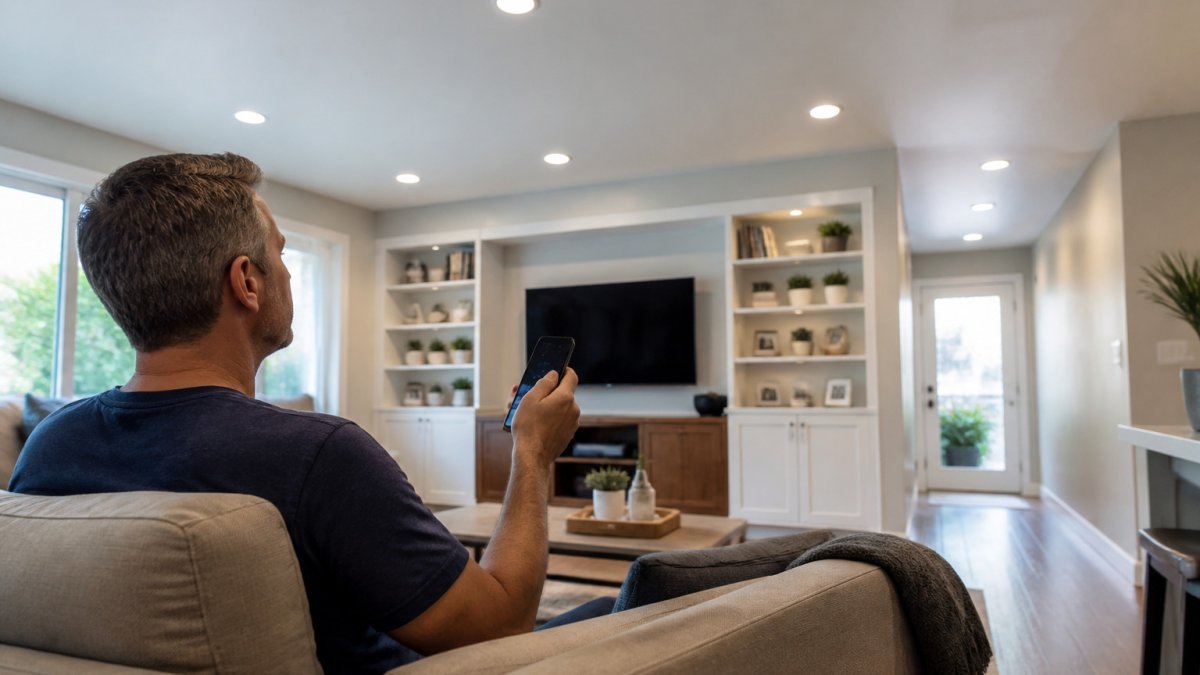
Remote control is one of the features people value most. The lights you can reach from anywhere are the lights you are more likely to actually use well.
Automation, Schedules and Voice Control
Automation is where smart lighting becomes truly useful. Browse our lighting products and options to see which fixtures support schedules and voice control. You can set lights to turn on at sunset, dim at bedtime, or start slowly in the morning.
- Set schedules for regular times, like evenings or weekends
- Create scenes for movie nights, dinners or reading
- Use voice assistants to control lights hands-free
- Use motion sensors so hallway lights turn on only when someone walks by
Voice control is especially handy when your hands are full.
Home Security Benefits of Smart Lighting
Smart lighting can help make your home look occupied when you are away. Lights that follow a schedule or switch on at random times can discourage intruders who watch for an empty house. Motion-activated outdoor lights also make approaches to your home more visible.
Security is one benefit where the feature set matters. Check that any system you choose works with the security devices you already have.
Smart Bulbs vs. Smart Switches: Which Fits Your Home
Smart bulbs screw into existing sockets and work with lamps, so they are easy to add. Smart switches replace the wall switch and control every bulb on that circuit, which suits ceiling fixtures and built-in lights.
A simple rule: use smart bulbs for lamps and portable lights, and smart switches for fixed ceiling lights you want to control as a group. Many homes use both.
Costs, Trade-offs and Installation: Planning Your Smart Lighting Upgrade
Most guides list the benefits and stop there. This section covers what the upgrade actually costs, what can go wrong, and how to judge whether it pays back, the questions readers ask before they buy.
What drives the cost
Smart lighting costs scale with four variables: the number of bulbs and switches, the feature tier (dimming only versus full color and tunable white), whether you need a hub or bridge, and the labor to install switches or wiring. A single smart bulb is the cheapest entry point; a whole-home setup with smart switches, a hub and professional installation is the most expensive. Because prices change frequently, confirm current pricing with the manufacturer or a licensed installer rather than relying on a published figure.
Payback period, realistically
Payback is the time it takes energy savings to equal the upfront cost. The math is straightforward: annual savings equals the kilowatt-hours you avoid multiplied by your utility rate, and payback equals upfront cost divided by annual savings. In homes that already use LEDs, the control layer alone often produces modest savings, so payback can be long. In homes still running incandescent or halogen bulbs, the combined bulb-and-control savings shorten it considerably.
Compatibility and setup requirements
Before buying, confirm four things:
- Protocol: Wi-Fi bulbs connect directly to your router; Bluetooth has limited range; Zigbee and Z-Wave require a hub. Matter is the newer cross-platform standard, and support varies by product.
- Platform: Check that the product works with the voice assistant and app you already use, and whether it needs a manufacturer account.
- Wiring: Smart switches generally need a neutral wire in the box. Older homes may lack one, which can rule out switch-based setups or add labor.
- Renters: Bulbs and plug-in modules are removable and renter-friendly; replacing wall switches is not, and may require landlord approval.
Trade-offs and limitations
- Internet outages: Cloud-dependent systems can lose app and voice control when the connection drops. Look for local control or switch-level fallback.
- Switch usability: Some smart bulbs must stay powered, which means the wall switch becomes a problem if someone turns it off. Smart switches avoid this.
- Interoperability: Mixing brands can break scenes and automations. Staying within one ecosystem, or choosing Matter-certified products, reduces friction.
- Service changes: A manufacturer that discontinues its app or cloud service can strand older devices. Check the company’s track record before committing.
- Maintenance: Firmware updates, battery-powered sensors and occasional re-pairing are part of ownership.
Privacy and cybersecurity
Connected lighting collects usage data and depends on account security. Use a unique password, enable two-factor authentication where offered, review app permissions, keep firmware current, and put devices on a separate network if your router supports it. These steps matter more as the number of connected devices grows.
Installation
Installation ranges from a simple bulb swap to a larger job involving switches, dimmers and wiring. If you are unsure about electrical work, hire a licensed electrician. If you are comparing installers, read our comparison of Progressive Electric LV and other Las Vegas electricians. For related electrical work, see our guide to electrical panel upgrade costs.
Before you buy, these are the main cost drivers, compatibility checks and trade-offs the article covers.
|
Factor |
What to check |
Why it matters |
|---|---|---|
|
Cost drivers |
Bulb and switch count, feature tier, hub, labor |
Sets the total upfront price |
|
Wi-Fi bulbs |
Connects directly to router |
No hub needed |
|
Zigbee or Z-Wave |
Requires a hub |
Needs extra equipment |
|
Smart switches |
Neutral wire in the box |
Older homes may lack one |
|
Renters |
Bulbs and plug-ins are removable |
Wall switch changes may need approval |
|
Internet outage |
Local control or switch fallback |
Cloud systems can lose control |
|
Mixed brands |
Matter-certified or one ecosystem |
Mixing brands can break scenes |
Booking Your Smart Lighting Consultation With Progressive Electric LV
Smart lighting can save energy, add convenience, support home security and make your home easier to run. The best setup depends on your rooms, your wiring and what you want from the system.
Progressive Electric LV is a local, family-owned business, and our licensed electricians can help you plan and install the right lighting for your home. Call us to talk through your options and request a quote.
Frequently Asked Questions
What is a smart home lighting system?
A smart home lighting system connects lights, switches or bulbs to a network so you can control them with a smartphone app, voice assistant, wall switch or automated schedule. Most systems use Wi-Fi, Bluetooth, Zigbee or Z-Wave to communicate with a hub or with each other. Many let you dim lights, change color temperature, set scenes for different activities and check whether lights are on when you are away from home. Compatibility with your existing wiring and devices should be confirmed before purchase.
Can smart lighting help reduce electricity use?
Yes, smart lighting can reduce electricity use mainly through LED efficiency, automatic schedules and dimming. Lights that turn off when rooms are empty or dim during daylight hours draw less power over time. The actual savings depend on how many fixtures you have, how long they run and your local electricity rates, so an electrician can help estimate the potential impact for your home.
Do smart bulbs work with regular light switches?
Smart bulbs can work with regular wall switches, but there is a common problem: if the wall switch is turned off, the bulb loses power and cannot receive app or voice commands. Smart switches solve this by replacing the wall switch itself, keeping the circuit powered while still allowing manual control. Many homeowners use smart switches for fixtures they control by wall, and smart bulbs for lamps or fixtures that stay powered.
Is smart home lighting difficult to install?
Simple smart bulbs can be installed in minutes by screwing them into existing sockets and connecting them through an app. Smart switches and whole-home systems involve replacing switches or wiring, which should be handled by a licensed electrician to meet electrical safety requirements. A licensed electrician such as Progressive Electric LV can help with installation for homes in the Las Vegas area. Current pricing depends on the number of fixtures, wiring conditions and system type, so contact Progressive Electric LV for a quote.
