

Last Updated: October 26, 2026
Quick Summary
The electrical panel upgrade cost ranges from $1,300 to $3,000 for a standard 100-amp-to-200-amp upgrade, though full service upgrades can reach $5,000 to $30,000 depending on your home’s electrical demands and site conditions. Labor, permits, and wiring upgrades represent the largest cost variables.
- A 100-amp-to-200-amp upgrade typically costs $1,300 to $3,000 and handles most modern electrical needs including air conditioning and moderate EV charging.
- Permit and inspection fees add $150 to $500, with utility disconnect and reconnect fees ranging from $100 to $300.
- Labor accounts for 40-60% of total cost, with licensed electricians charging $75 to $150 per hour for 4 to 8 hours of work.
- A 400-amp service upgrade for heavy demand ranges from $4,000 to $8,000 and requires heavier-gauge wiring and complex utility coordination.
- The full project timeline spans 1 to 3 weeks from contract to final inspection, with on-site installation taking 1 to 3 days.
Table of Contents
- What Does an Electrical Panel Upgrade Cost in 2026?
- 100-Amp to 200-Amp Panel Upgrade Cost Breakdown
- Electrical Panel Upgrade Permit Cost and Code Requirements
- Cost to Upgrade Electrical Panel for EV Charger Installation
- Labor, Materials, and Installation Factors That Drive Price
- Electrical Panel Upgrade Timeline and Project Scope
- Getting Your Panel Upgrade Quote from a Licensed Electrician
- Frequently Asked Questions
What Does an Electrical Panel Upgrade Cost in 2026?
Understanding the electrical panel upgrade cost is essential: a standard 100-amp-to-200-amp upgrade ranges from $1,300 to $3,000, though full service upgrades can reach $5,000 to $30,000 depending on your home’s electrical demands.
At Progressive Electric, we guide homeowners through this decision. Most fall into one of three scenarios: an amperage bump, a full panel replacement due to safety concerns, or a capacity expansion for new loads like EV chargers or heat pumps.
The challenge isn’t just the panel itself. Permit fees, inspection requirements, utility coordination, and site-specific conditions can add thousands to your quote. The City of Palo Alto’s guidance on electrical panel upgrades notes that strategic planning and smart equipment choices may sometimes avoid a costly upgrade altogether, making an upfront assessment critical.
100-Amp to 200-Amp Panel Upgrade Cost Breakdown
A 100-amp-to-200-amp upgrade typically costs $1,300 to $3,000, making it one of the most common residential projects. This amperage jump handles most modern electrical needs, air conditioning, electric water heaters, and moderate EV charging, without requiring a full service upgrade. NerdWallet’s 2026 electrical panel data reports an average replacement cost of $1,342, with reported ranges from $125 to $4,500 depending on labor intensity and local conditions.
A 150-amp panel runs $1,500 to $2,500 for homes needing more than 100 amps but not a full 200-amp service. A 200-amp panel upgrade, the most common residential standard today, costs $1,800 to $3,500 for the panel and installation alone.
For heavy demand, multiple heat pumps, large EV chargers, or pool equipment, a 400-amp service upgrade ranges from $4,000 to $8,000+, requiring heavier-gauge wiring, upgraded service masts, and complex utility coordination.
| Panel Amperage | Typical Cost Range | Best For | Complexity |
|---|---|---|---|
| 100-amp | $1,300-$2,000 | Older homes, minimal upgrades | Low |
| 150-amp | $1,500-$2,500 | Mid-range capacity needs | Medium |
| 200-amp | $1,800-$3,500 | Modern homes, EV chargers | Medium |
| 400-amp | $4,000-$8,000+ | Large commercial or multi-unit | High |
Electrical Panel Upgrade Permit Cost and Code Requirements
Permits and inspections typically add $150 to $500. A like-for-like swap with an online permit portal may cost $150 and one inspection; a full service upgrade changing the meter base, service entrance conductors, and grounding system can trigger a $400-$500 permit plus multiple inspections and a utility application.
Every panel upgrade requires a permit. Skipping it exposes you to code violations, failed inspections, liability, and complications at a future home sale.
What the Permit Actually Covers
A residential electrical permit for a panel upgrade generally covers:
- Removal and replacement of the panelboard and main breaker
- Branch-circuit breakers installed in the new panel
- Grounding and bonding of the service equipment
What it usually does not cover: utility-side work (the service drop or lateral, the meter itself, and the utility’s transformer), handled under a separate utility service application, a distinction homeowners often miss.
Code Requirements That Change the Scope
The National Electrical Code (NEC) sets minimum safety standards, and most jurisdictions adopt a specific edition, sometimes with amendments. Three code-driven items most often expand scope:
- AFCI protection. Arc-fault circuit interrupters are required on most branch circuits under modern code. Adding them across 15-20 circuits can add several hundred dollars in breakers alone.
- Grounding and bonding. Older homes may have a two-wire service or a grounding electrode system that doesn’t meet current requirements, requiring a new grounding electrode conductor, ground rods, and bonding of metallic piping.
- Working clearance and panel location. Code specifies clear working space in front of the panel; one tucked into a closet or behind a water heater may need relocation, adding labor and drywall repair.
Ask your electrician which code edition your jurisdiction has adopted and whether the quote includes AFCI breakers and grounding upgrades. A quote that omits them is not comparable to one that includes them.
The Inspection Sequence
Inspections happen in stages, affecting timeline and cost:
- Rough inspection (where required). Some jurisdictions inspect the service entrance, grounding, and wiring before the panel is fully enclosed or the meter is reconnected.
- Final inspection. After the work is complete, a municipal inspector verifies the panel, breakers, wiring, grounding, and labeling.
- Utility reconnect. The utility may require proof of inspection before re-energizing the service.
Inspection fees commonly run $75 to $200 each, and a service upgrade may require two or three. Some jurisdictions bundle them into the permit fee; others charge per visit.
Utility Coordination: Who Does What and Who Pays
Service upgrades involve work on both sides of the meter, a common source of budget surprises.
| Task | Typically Performed By | Typically Paid By |
|---|---|---|
| Disconnect and reconnect service | Utility | Homeowner (utility fee, often $100-$300) |
| Meter base replacement | Licensed electrician | Homeowner (part of project quote) |
| Service entrance conductors and mast | Licensed electrician | Homeowner (part of project quote) |
| Service drop or lateral upgrade | Utility | Utility, or homeowner if a service upgrade is requested |
| Transformer upgrade | Utility | Utility |
Typically, the electrician handles everything from the meter base inward and coordinates the disconnect, while the utility handles the service drop and meter. A new service application can add one to three weeks before reconnect.
Do not let anyone reconnect a service without utility approval. Re-energizing a service that has not passed inspection can void insurance coverage and create liability.
How to Verify Requirements Before You Budget
- Call your building department for the permit fee schedule and inspection requirements.
- Ask your utility for its service upgrade application, disconnect/reconnect fees, and review timeline.
- Confirm which NEC edition your jurisdiction enforces and whether local amendments apply.
A well-sourced quote names the permit fee, inspection fees, utility disconnect/reconnect fee, and any utility application charges. If yours doesn’t, ask for them in writing before comparing bids.
Cost to Upgrade Electrical Panel for EV Charger Installation
A Level 2 home charger (240V) typically draws 30-50 amps, which can exceed a 100-amp panel’s capacity, especially with high baseline demand from HVAC and water heating. The cost to upgrade electrical panel for EV charger installation ranges from $1,500 to $3,000 for a modest amperage increase, though full service upgrades can push toward $5,000.
First, a licensed electrician performs a load calculation to determine whether your panel can safely supply the charger. If you have 40+ amps spare, a dedicated circuit may avoid an upgrade entirely; if capacity is tight, a 100-to-150-amp or 100-to-200-amp upgrade becomes necessary.
EV charging also influences the type of upgrade you choose. However, if you plan future additions, a second EV, heat pump conversion, or solar installation, you might upgrade to 200 amps now to avoid a second expensive upgrade later. Learn more about our EV charging installation services to discuss whether a panel upgrade is necessary for your specific charging setup.
Labor, Materials, and Installation Factors That Drive Price
Labor typically accounts for 40-60% of your total panel upgrade cost. A licensed electrician charges $75 to $150 per hour, and a standard replacement takes 4 to 8 hours.
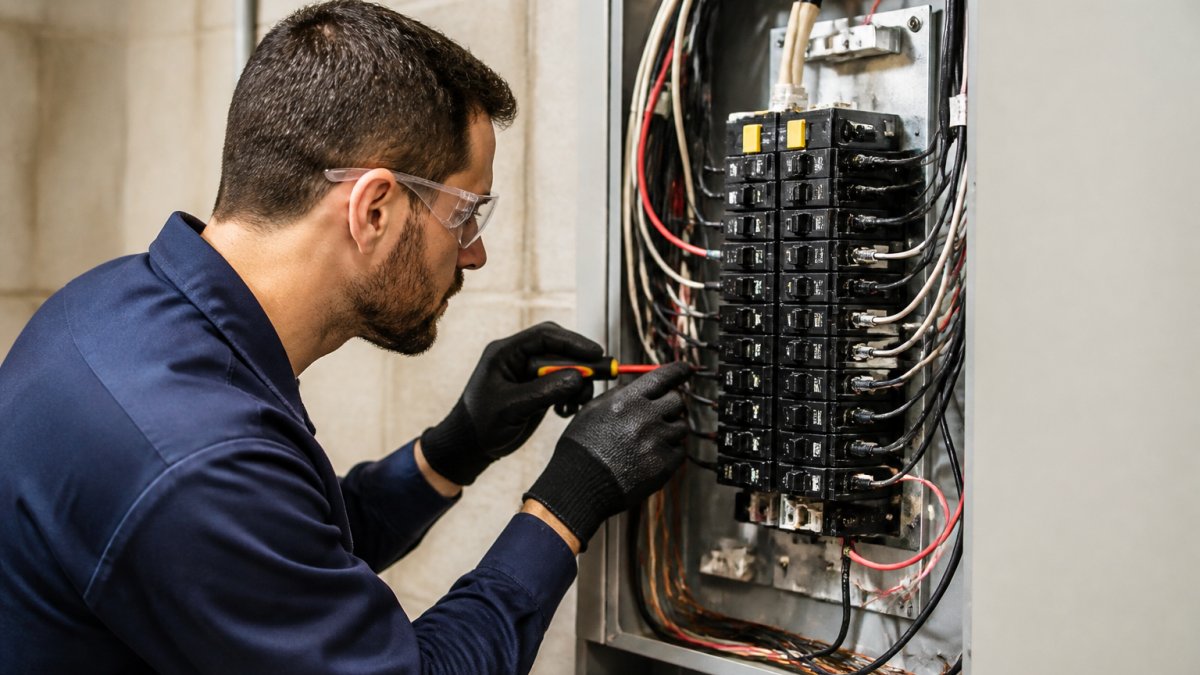
Site conditions dramatically affect labor. An accessible garage panel takes less time than one buried in a basement corner or behind finished walls.
Standard residential panels cost $200 to $600; heavy-duty or specialty panels run $800 to $1,200. Breakers range from $15 to $50 each.
Electrical Panel Upgrade Timeline and Project Scope
A typical electrical panel upgrade takes 1 to 3 days of on-site work, but the full project stretches to 1 to 3 weeks from signed contract to final inspection once permits, utility coordination, and inspections are included. Service upgrades requiring a utility application can run 3 to 6 weeks.
A Realistic Week-by-Week Timeline
| Stage | Typical Duration | What Happens |
|---|---|---|
| Assessment and quote | 1-3 days | Load calculation, site inspection, written quote |
| Permit application | 3-10 business days | Building department review and issuance |
| Utility service application (if applicable) | 1-3 weeks | Utility reviews capacity and schedules disconnect |
| On-site installation | 1-3 days | Removal, installation, wiring, testing |
| Rough inspection (where required) | 1-5 business days | Inspector verifies service entrance and grounding |
| Final inspection | 1-5 business days | Inspector verifies completed work |
| Utility reconnect | Same day to 1 week | Utility re-energizes service after inspection |
Straightforward replacements with online permitting often compress to about a week; full service upgrades with a mast replacement or meter base change sit at the long end.
Power Interruption: What to Expect
The main service is off during installation, typically 2 to 4 hours for a panel replacement and 4 to 8 hours for a service upgrade with a mast or meter base change. Plan for:
- Refrigeration. Keep doors closed; food stays safe about 4 hours in a closed refrigerator and 24-48 hours in a full freezer.
- Medical equipment. Arrange a backup power source or temporary stay elsewhere.
- Work and school. Expect no internet, air conditioning, or hot water during the outage.
Some electricians schedule the disconnect for early morning to minimize disruption, adding a day or two to scheduling but shortening the actual outage.
Preparing Your Home and Panel Area
The electrician needs clear access to the panel and working space. Before the crew arrives:
- Clear at least 3 feet in front of and around the panel.
- Remove shelving, stored items, and anything mounted near the panel.
- Provide access to the meter and service entrance, including the exterior mast wall.
Repair Versus Replace: A Decision Guide
Not every panel problem requires a full replacement. An electrician’s evaluation typically sorts the situation into one of three paths:
- Repair. A failed breaker, loose connection, or damaged bus bar can sometimes be repaired if the panel is current-production with available parts and the enclosure and bus are sound, the lowest-cost path when equipment is otherwise healthy.
- Panel replacement only. If capacity is adequate but the panel is aged, damaged, or obsolete, a like-for-like replacement restores safety without changing amperage.
- Full service upgrade. If the load calculation shows more capacity is needed, or the service entrance and meter base are undersized or deteriorated, the scope expands to a service upgrade.
Hazardous Panel Brands and Safety Signals
Some panel brands are associated with elevated failure or fire risk and are commonly recommended for replacement rather than repair:
- Federal Pacific Electric (FPE) Stab-Lok panels. Known for breakers that may fail to trip under overload.
- Zinsco panels. Known for bus bars that can overheat and for breakers that may not trip reliably.
- Pushmatic panels. Obsolete, with limited breaker availability.
If your panel is an FPE or Zinsco, or shows signs of overheating, have it evaluated by a licensed electrician before adding new loads such as an EV charger or heat pump. Adding load to a failing panel increases risk.
When an Unplanned Scope Change Happens
A pre-upgrade inspection is the best defense against mid-project surprises, but opening the wall can reveal hidden conditions:
- Aluminum branch-circuit wiring requiring remediation
- A grounding electrode system that doesn’t meet code
- Corroded or undersized service entrance conductors
A well-written quote states how change orders are priced and requires written approval before additional work proceeds. Ask for that language before you sign.
Budget a contingency of 10-20% above the quoted price for a panel upgrade, and confirm in writing how change orders are approved. The most common budget overruns come from grounding, service entrance, and wiring conditions discovered after work begins.
Getting Your Panel Upgrade Quote from a Licensed Electrician
Your first step is a professional assessment. Contact Progressive Electric LV for your panel upgrade quote to schedule your home’s electrical evaluation.
The electrician also checks for safety hazards, outdated panels, improper grounding, overloaded circuits, deteriorating wiring, and identifies permit and code requirements.
Contact Progressive Electric LV for your panel upgrade quote. Our licensed electricians provide transparent estimates with no hidden fees, breaking down every component so you understand exactly what you’re paying for.
Frequently Asked Questions
How much does it cost to upgrade an electrical panel in 2026?
The electrical panel upgrade cost typically ranges from $1,300 to $4,000 for a standard 100-amp to 200-amp upgrade, depending on labor, permits, and whether wiring upgrades are needed. A full service upgrade can reach $5,000 to $30,000. Your final cost depends on your home’s current panel condition, local electrical codes, and the scope of work required. Contact a licensed electrician for an itemized estimate based on your specific situation.
What is the typical cost to upgrade from a 100-amp to a 200-amp panel?
A 100-amp to 200-amp panel upgrade typically costs between $1,300 and $3,000, depending on labor, permits, and whether wiring upgrades are necessary. This is the most common residential upgrade. Costs vary based on your home’s existing electrical system condition, site accessibility, and local installation complexity. Permit and inspection fees add to the total. Request quotes from multiple licensed electricians to compare pricing for your exact project scope.
Does an electrical panel upgrade require a permit?
Yes, electrical panel upgrades require a permit in most jurisdictions. Permit fees vary by location and typically range from $50 to $500 or more. The permit process includes a code inspection to ensure the work meets current electrical safety standards and grounding requirements. Your electrician will usually handle permit applications and coordinate inspections. Skipping permits can create liability issues, affect insurance claims, and result in fines. Always verify permit requirements with your local building department.
Can I upgrade my electrical panel to support an EV charger?
Yes, you can upgrade your electrical panel to support an EV charger, but many homes require a panel upgrade to handle the additional power demand. A Level 2 charger typically requires 40-60 amps of dedicated capacity. If your current panel lacks available circuits or amperage, you’ll need an upgrade. The cost to upgrade electrical panel for EV charger installation depends on your existing capacity and whether a full service upgrade is needed. A licensed electrician can assess your home’s electrical system and calculate the required capacity to determine if an upgrade is necessary and what the cost will be.
How long does it take to replace or upgrade an electrical panel?
An electrical panel upgrade typically takes one to three days, depending on project scope and site conditions. A standard panel replacement may take 4-8 hours, while a full service upgrade with new wiring can extend the timeline to 2-3 days. The electrical panel upgrade timeline also includes permit approval and inspection scheduling, which can add 1-2 weeks before work begins. Your home will experience a brief power interruption during installation. Coordinate with your electrician and utility company to plan the project and minimize disruption.
